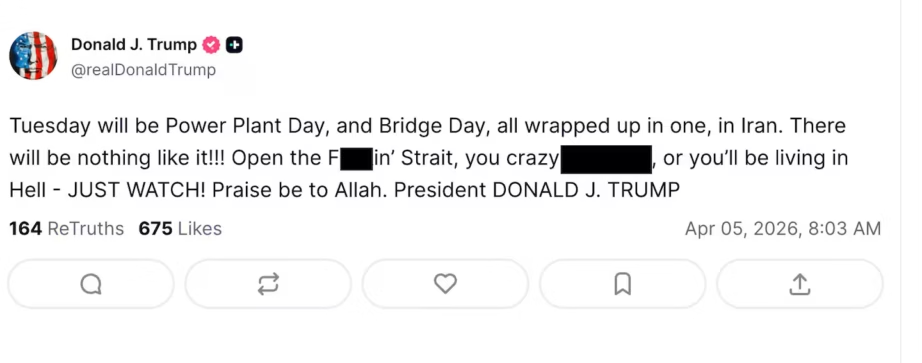
When Donald Trump says “evil won’t prevail” on Easter, it doesn’t just sound like faith.
It turns faith into a weapon.
The most dangerous people in history didn’t believe in evil. They believed they’d been chosen to end it.
When Trump says “evil won’t prevail” on Easter, he’s not expressing faith.
He’s borrowing the grammar of sacrifice , a story about suffering, transformation, restraint and running a war through it.
Easter works as a frame precisely because it’s unchallenged. Nobody argues with resurrection. So if your enemy is “evil,” and God already picked the winner, then Iran isn’t a state with interests and leverage and forty million people who didn’t choose their government.
It’s a category and categories don’t negotiate, they get defeated.
This is how moral certainty becomes operational. Not in the decision to use force, that’s a calculation. In the decision that the other side forfeited their claim to complexity.
History doesn’t run short on believers. It runs short on hesitation.
The wars that destroyed the most weren’t fought by people who loved destruction. They were fought by people absolutely convinced they were the cure.
We’re not being led by idiots. That would be easier. Idiots don’t build systems this effective.
Look at who wins now. The loudest. The fastest. The most certain. Not the most right. Not the most useful. Just the easiest to consume and our world is a mess! They’re not stupid. They’re optimized. Politicians perform clarity because solving problems is slow and slow doesn’t trend. Celebrities borrow urgency because urgency travels and understanding doesn’t. Creators package reality because packaged reality gets shared and complicated reality sits there, unread, quietly rotting.
Here’s the part that doesn’t go down easy. You built this. Not on purpose. Not out of malice. But every time you paused on outrage instead of scrolling past it, every time you shared something because it made you feel right rather than because it was right, every time you chose the clean take over the messy truth you were casting a vote. You trained the system. Now it trains back. It feeds you sharper versions of what you already believe. Removes cost. Depth costs attention. So depth goes.
The people rising to the top start to look thinner. Not because they’re incapable. Because the system doesn’t filter out weight. It just pays more for lightness. So everything sounds confident. Nothing actually helps. Nothing improves.
Ask a better question. Not “why are they so dumb?” That question flatters you. Keeps you in the audience. Watching. Judging. Untouched.
Ask instead what someone intelligent would even look like in a system that punishes thinking. Would they go viral? Would you slow down long enough to notice them? Or would they disappear under someone louder, faster, more certain?
If the answer is no, and it probably is ,then we’re not selecting leaders.
We’re selecting for a feeling.
The feeling that things make sense and if someone actually told you the truth, slowly, with doubt, without performance… you’d scroll.
There are moments when an industry accidentally tells the truth. This was one of them. Anyone who has spent time inside a holding company has seen versions of this before.
WPP cut thousands of people in the name of transformation. Then found room for a $14.7 million CEO package. 7,000 people removed from the system. $14.7 million added to explain why. The number will get attention. It shouldn’t be the focus.
Because the real signal isn’t how much was paid.
It’s what had to be removed to make that payment feel acceptable. A company once worth roughly £24 billion now sitting closer to £3.1 billion. A business telling the market it needs AI, simplification, discipline. Then this. Not quietly. Publicly. Structurally. That’s not a contradiction. That’s a hierarchy and hierarchies reveal themselves fastest under pressure. Agencies don’t sell creativity. They sell the illusion that creativity still lives inside the structure. When stress hits, the system behaves exactly as designed. The people doing the work become cost. The people explaining the system become value. Not because they create more impact.
Because they sit closer to capital. That’s the part clients should pay attention to.
Every procurement team, every CMO, every brand that still believes they are buying thinking, craft, or cultural edge.
You’re not just buying output. You’re buying a structure and that structure is quietly telling you where your money goes when things tighten. Most clients already know this.
They sit in meetings where the senior minds pitch the work, then disappear the moment the contract is signed. What’s left is a rotating cast of juniors, deadlines, and alignment calls.
The system works. Just not in the way it’s sold. The difference now is friction has collapsed. AI reduces coordination cost. Execution is modular. Distribution is instant. The original reason these structures existed is weakening in real time. But the overhead remains. So the system compensates. Cuts deeper into talent. Invests harder in narrative. Hopes the gap isn’t noticed. It is.
You can already see the response forming. Senior talent stepping out. Micro-agencies forming around reputation, not structure. Clients quietly testing smaller partners who actually do the work. Not out of rebellion. Out of math.
Because once you see where the value is really created, it becomes difficult to keep paying for where it isn’t. The agencies that navigate this shift won’t be the biggest. They’ll be the ones that can prove where value is actually created and protect it.
The latest rankings place Greece near the bottom of the EU. Not shocking. What matters is the gap they point to.
We still lean on the origin story. The birthplace. The inheritance. As if that carries forward on its own. It doesn’t.
What matters is how power behaves on an ordinary day. Not in speeches. In decisions. Which rules get enforced. Which ones quietly don’t. Who gets access. Who gets investigated. Which story runs. Which one never quite makes it.
That’s where the picture changes. Nothing dramatic breaks. No visible rupture. A story gets softened before it lands. A regulator moves slower than it should. Pressure shows up, just not in the same places every time. The system keeps its shape. The balance shifts inside it.
Closer to power starts to matter more than being right. Disagreeing carries a cost you can’t always see upfront. Staying aligned becomes the safer move. That’s where trust starts to thin out. Rules feel negotiable.
Relationships carry more weight than they should. Credibility becomes something individuals have to build and defend on their own.
From the outside, it still looks like it works. Up close, it feels different and the origin story doesn’t soften that. It sharpens it.
Because Europe isn’t comparing Greece to its past. It’s comparing it to its peers and the gap is no longer subtle enough to ignore