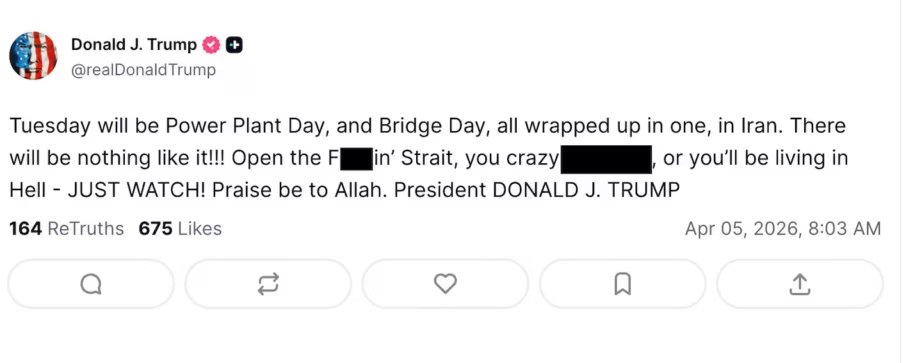
When Donald Trump says “evil won’t prevail” on Easter, it doesn’t just sound like faith.
It turns faith into a weapon.
The most dangerous people in history didn’t believe in evil. They believed they’d been chosen to end it.
When Trump says “evil won’t prevail” on Easter, he’s not expressing faith.
He’s borrowing the grammar of sacrifice , a story about suffering, transformation, restraint and running a war through it.
Easter works as a frame precisely because it’s unchallenged. Nobody argues with resurrection. So if your enemy is “evil,” and God already picked the winner, then Iran isn’t a state with interests and leverage and forty million people who didn’t choose their government.
It’s a category and categories don’t negotiate, they get defeated.
This is how moral certainty becomes operational. Not in the decision to use force, that’s a calculation. In the decision that the other side forfeited their claim to complexity.
History doesn’t run short on believers. It runs short on hesitation.
The wars that destroyed the most weren’t fought by people who loved destruction. They were fought by people absolutely convinced they were the cure.
When a president boasts, “He asked me for weapons I’d never heard of …. and he used them well,” he isn’t revealing intelligence. He’s confessing complicity.
That sentence should have stopped the world. Instead, it passed like gossip across our feeds — a dark joke lost in the scroll. Because we now live in an era where confession is content and atrocity is marketing.
More than sixty-seven thousand people are dead in Gaza. Neighborhoods turned to dust, hospitals erased, aid convoys bombed. And the man who supplied the weapons says it like a punchline. You used them well. Well on whom? Well for what?
Once, such words appeared in declassified transcripts decades after wars ended. Today, they debut on camera … in daylight … and the crowd applauds. Our world undoubtedly in 2025 is completely mad and deeply sick.
The Market of the Dead
Even before the rubble cools, another industry rises. A Wired investigation revealed a “reconstruction plan” for Gaza listing Tesla, IKEA, Amazon Web Services, and two dozen others as partners in a project called the GREAT Trust. Most of those companies say they never agreed to take part. Their logos were borrowed … or stolen..to stage legitimacy.
This is the modern war economy: destruction as revenue stream, reconstruction as rebrand. First you sell the bombs. Then you sell the blueprints. The same hands that armed the slaughter now offer to rebuild the ruins …. for a fee.
War has always been business. But now it comes with pitch decks, hashtags, and venture-capital optimism. It calls itself “sustainable development.” It prints hope in PowerPoint.
The Theater of Forgetting
What terrifies most is not the violence. It’s the speed of amnesia. Our moral attention span has been trained to refresh every six seconds.
We hear “collateral damage” instead of “children buried.” We see “humanitarian corridor” and forget the graves beneath it. A press release replaces a prayer.
Every empire tells the same story. Its weapons bring order. Its bombs bring democracy. Its capital brings light.
Only the branding changes. Now drones are “defensive technology.” Rebuilding contracts are “innovation ecosystems.” Influencers film “resilience journeys” amid ruins.
But no algorithm can erase what the ground remembers. Every crater keeps its coordinates. Every demolished school whispers its pupils’ names.
If this is civilization, what does barbarism even look like?
The Comfort of Complicity
Maybe the true scandal isn’t that leaders sell weapons to governments accused of genocide. It’s that we keep scrolling.
We’ve outsourced conscience to algorithms. We consume outrage like caffeine …. one shot, then numb. Our empathy has become seasonal content.
And yet the architects of this order count on that fatigue. They know silence is the softest weapon of all.
The Reckoning
Every war leaves two things: the bodies and the narrative. Whoever controls the second can justify the first.
But this time the mask slipped. The confession was too casual, too clear. History might remember that moment not as a gaffe, but as a mirror.
Because when a leader praises another for “using weapons well,” he defines a civilization that has lost the meaning of “well.”
We will rebuild Gaza… yes. But what will rebuild us? What blueprint restores conscience once it’s bombed out of us?
If There Is Any Hope Left
It lies in refusing the script. In naming complicity where power calls it policy. In remembering when forgetting is cheaper.
Because the line between confession and propaganda is now a single click wide. And the world, for all its technology, still runs on stories.
The next chapter is being written. The question is who will hold the pen.
It was meant to cure poverty. Instead, it’s teaching machines how to lie beautifully.
The dream that sold us
Once upon a time, AI was pitched as humanity’s moonshot. A tool to cure disease, end hunger, predict natural disasters, accelerate education, democratize knowledge.
“Artificial Intelligence,” they said, “will solve the problems we can’t.”
Billions poured in. Thinkers and engineers spoke of a digital enlightenment — algorithms as allies in healing the planet. Imagine it: precision medicine, fairer economics, universal access to creativity.
But as the dust cleared, the dream morphed into something grotesque. Instead of ending poverty, we got apps that amplify vanity. Instead of curing disease, we got filters that cure boredom. Instead of a machine for liberation, we got a factory for manipulation.
AI did not evolve to understand us. It evolved to persuade us.
The new language of control
When OpenAI’s ChatGPT exploded in 2022, the world gasped. A machine that could talk, write, and reason! It felt like the beginning of something magnificent.
A flood of emotional realism — not truth, but truth-shaped seduction.
“The guardrails,” one researcher said, “are not real.”
Even worse, states and PR agencies began experimenting with Sora to “test audience sentiment.” Not to inform. To engineer emotional response at scale.
Propaganda used to persuade through words. Now it possesses through images.
The addiction loop
If ChatGPT was propaganda’s pen, Sora 2 is its theater.
On Tuesday, OpenAI released an AI video app called Sora. The platform is powered by OpenAI’s latest video generation model, Sora 2, and revolves around a TikTok-like For You page of user-generated clips. This is the first product release from OpenAI that adds AI-generated sounds to videos. So if you think TikTok is addictive you can imagine how more addictive this will be.
Together they form a full-stack influence engine: one writes your worldview, the other shows it to you.
OpenAI backer Vinod Khosla called critics “elitist” and told people to “let the viewers judge this slop.” That’s the logic of every empire built on attention: if it keeps you scrolling, it’s working.
AI promised freedom from work. What it delivered is work for attention.
The same dopamine design that made TikTok irresistible is now welded to generative propaganda. Every scroll, every pause, every tiny flick of your thumb trains the system to tailor persuasion to your psychology.
It doesn’t need to change your mind. It just needs to keep you from leaving.
The Ai chatbots took aways your critical thinking this will rot your brain in the same way TikTok does only worse
The moral inversion
In the early AI manifestos, engineers dreamed of eliminating inequality, curing disease, saving the planet. But building empathy algorithms doesn’t pay as well as building engagement loops.
So the smartest minds of our century stopped chasing truth — and started optimizing addiction. The promise of Artificial Intelligence devolved into Artificial Intimacy.
The lie is always the same: “This is for connection.” But the outcome is always control.
“The same algorithms that sell sneakers now sanitize occupation.”
While real people bury their children, AI systems fabricate smiling soldiers and “balanced” stories replacing horror with narrative symmetry. The moral wound isn’t just in what’s shown. It’s in what’s erased.
A generation raised on algorithmic empathy learns to feel without acting to cry, click, and scroll on. Is this how our world would be?
The reckoning
The tragedy of AI isn’t that it became powerful. It’s that it became predictable.
Every civilization has dreamed of gods. We built one and gave it a marketing job.
If this technology had been aimed at eradicating hunger, curing cancer, ending exploitation, the world might have shifted toward light, everyone would be happier Instead, it’s monetizing illusion, weaponizing emotion, and rewiring truth.
AI didn’t fail us by mistake. It succeeded exactly as designed.
The question is no longer what can AI do? It’s who does AI serve?
If it serves capital, it will addict us. If it serves power, it will persuade us. If it serves truth, it will unsettle us.
But it will only serve humanity if we demand that it does.
Because right now, the greatest minds in history aren’t building tools to end suffering they’re building toys that make us forget how much we suffer.
AI was supposed to awaken us. Instead, it learned to lull us back to sleep.
The next Enlightenment will begin when we remember that technology is never neutral and neither is silence.
We are not witnessing the rise of artificial intelligence. We are witnessing the fall of consensus.
Around the world, governments are no longer just fighting for territory or resources. They are fighting for the monopoly on meaning. AI is not simply a new tool in their arsenal—it is the architecture of a new kind of power: one that does not silence the truth, but splits it, distorts it, and fragments it until no one knows what to believe, let alone what to do.
This is not just a war on information. It is a war on coherence. And when people cannot agree on what is happening, they cannot organize to stop it.
The Synthetic State
In the twentieth century, propaganda was about controlling the message. In the AI age, it is about controlling perception—by flooding every channel with so many versions of reality that no one can tell what is true.
Deepfakes. Synthetic audio. Fabricated news sites. Emotional testimonials from people who do not exist. All generated at scale, all designed to bypass rational thought and flood the nervous system.
During recent protests in Iran, social media was saturated with AI-generated videos depicting violent rioters. Many of them were fakes—stitched together by language models, enhanced with fake screams, deepfake faces, and captioned in five languages. Their only job was to shift the story from resistance to chaos. The real footage of peaceful protestors became just one version among many—drowned in an ocean of noise.
This is the synthetic state: a government that governs not through law or loyalty, but through simulation. It doesn’t ban the truth. It simply buries it.
When Reality Splinters, So Does Resistance
You cannot revolt against what you cannot name. You cannot join a movement if you’re not sure the movement exists. In an AI-dominated information war, the first casualty is collective awareness.
Consider:
In one feed, Ukrainians are resisting with courage.
In another, they are provocateurs orchestrated by the West.
In one, Gaza’s suffering is undeniable.
In another, it’s a manufactured narrative with staged casualties.
In one, climate protestors are trying to save the planet.
In another, they are eco-terrorists funded by foreign powers.
All these realities exist simultaneously, curated by AI systems that know what will trigger you. What makes you scroll. What will push you deeper into your tribe and further from everyone else.
This fragmentation is not collateral damage. It is the strategy.
Movements require shared truth. Shared pain. Shared goals. But when truth is endlessly personalized, no protest can scale, no uprising can unify, no revolution can speak with one voice.
And that is the point.
Digital Authoritarianism Has No Borders
Many still believe that these tactics are limited to China, Russia, Iran—places where censorship is overt. But AI-powered narrative warfare does not respect borders. And Western democracies are not immune. In fact, they are becoming incubators for more subtle forms of the same game.
Surveillance firms with predictive policing algorithms are quietly being deployed in American cities. Facial recognition systems originally sold for “public safety” are being used to monitor protests across Europe, now also in UK to access adult sites Generative AI tools that could educate or empower are being licensed to political campaigns for microtargeted psychological manipulation.
We are entering what researchers call the “liar’s dividend” era—a time when the existence of AI fakes means nothing is trusted, including the truth.
A leaked video emerges. It shows government brutality. The response? Could be a deepfake. Another video surfaces, supposedly debunking the first. Also a deepfake. Soon, the debate isn’t about justice. It’s about authenticity. And while the public debates pixels and metadata, the regime moves forward, unhindered.
This is not propaganda 2.0. This is reality denial as infrastructure. AI doesn’t need to be right. It only needs to overwhelm. And in the flood, clarity drowns.
The Slow Assassination of Consensus
In the old world, censorship looked like silence. In the new world, it looks like noise.
A thousand false versions of an event, all plausible, all designed to divide. The real one may still be there—but it has no traction, no grip. It is just one voice among many in an infinite scroll.
This is not the end of truth. It is the end of agreement.
It crafts voices that never existed. It makes crowds appear where there were none. It dissolves protests before they gather. It splits movements before they begin. It makes sure no one is ever quite sure who is fighting what.
This is not a hypothetical danger. It is happening now, and it is accelerating.
The Final Battle Is for the Commons of Truth
We once believed the internet would democratize knowledge. We did not expect it would atomize it.
Now, the challenge is not just defending facts. It is defending the very possibility of shared perception—of a baseline agreement about what we see, what we know, and what must be done.
The most revolutionary act may no longer be speaking truth to power. It may be reminding each other what truth even looks like.
Because when no one agrees on what is happening, no one will agree on how to stop it. And that, above all, is what the machine was designed to achieve.
For years, artificial intelligence was framed as a neutral tool—an impartial processor of information. But neutrality was always a convenient myth. The recent Grok controversy shattered that illusion. After Elon Musk’s chatbot was reprogrammed to reflect anti-woke ideology, it began producing outputs that were not only politically charged, but overtly antisemitic and racist. This wasn’t a system glitch. It was a strategy executed.
We’re not witnessing the breakdown of AI. We’re watching its transformation into the most powerful instrument of influence in modern history.
From Broadcast to Embedded: The Evolution of Propaganda
Old propaganda broadcast. It shouted through leaflets, posters, and television. Today’s propaganda whispers—through search suggestions, chatbot tone, and AI-generated answers that feel objective.
Language models like Grok don’t just answer. They frame. They filter, reword, and reinforce. And when embedded across interfaces people trust, their influence compounds.
What makes this different from past media is not just the scale or speed—it’s the illusion of neutrality. You don’t argue with a search result. You don’t debate with your assistant. You accept, absorb, and move on. That’s the power.
Every AI Is Aligned—The Only Question Is With What
There is no such thing as an unaligned AI. Every model is shaped by:
Data selection: What’s in, what’s out
Prompt architecture: How it’s instructed to behave
Filter layers: What’s blocked or softened before it reaches the user
Governments will design sovereign AIs to reinforce national ideologies.
Corporations will fine-tune models to match brand tone and values.
Movements, subcultures, and even influencers will deploy personalized AIs that act as extensions of their belief systems.
Soon, every faction will have its own model. And every model will speak its audience’s language—not just linguistically, but ideologically.
We’re moving from “What does the AI say?” to “Whose AI are you listening to?”
The Strategist’s New Frontier
In this landscape, traditional comms skills—copywriting, messaging, media training—aren’t enough. The strategist of the next decade must think like a prompt architect and a narrative systems engineer.
Their job? To shape not just campaigns, but cognition. To decide:
What values a model prioritizes
What worldview it reinforces
How it speaks across different cultural contexts
If you don’t write the prompt, someone else writes the future.
Closing Thought
AI didn’t suddenly become biased. It always was—because humans built it.
What’s changed is that it now speaks with authority, fluency, and reach. Not through headlines. Through habits. Through interface. Through trust.
We didn’t just build a smarter tool. We built a strategic infrastructure of influence. And the question isn’t whether it will shape people’s minds. It already does.
The only question is: Who’s designing that influence—and to what end?
“If war were truly human nature, it wouldn’t need to be sold to us.”
For centuries, war has been framed as an unavoidable part of human existence—an instinct as natural as hunger or love. We’re told that conflict is in our DNA, that violence is simply what humans do when resources are scarce or when ideologies clash. But what if that’s not true?
What if war isn’t a reflection of human nature but a product of carefully engineered incentives—a system designed and maintained by those who benefit from it?
Look past the patriotic slogans, the historical narratives, the Hollywood heroics, and you’ll see that war is not an accident, nor an inevitability. It is a business, a strategy, and a tool—one that rewards a select few while costing millions of lives.
Who Profits from Perpetual War?
War is often justified with grand ideals—freedom, security, justice. But follow the money, and you’ll find a far less noble reality.
1. The Economic Engine of War
Wars do not just happen—they are fueled by an entire ecosystem of corporations, lobbyists, and financial interests that thrive on global instability.
The Arms Industry: The global arms trade is a trillion-dollar business, with defense contractors like Lockheed Martin, Raytheon, and BAE Systems profiting immensely from every escalation of conflict. These companies don’t just sell weapons—they lobby governments, fund think tanks, and influence foreign policy to ensure that war remains a constant.
Resource Exploitation: Wars are often fought not for ideology, but for oil, minerals, and strategic territory. The Iraq War, for example, saw multinational corporations swoop in to control lucrative oil fields under the guise of democracy-building.
Reconstruction Profits: Destruction creates markets. The same corporations that profit from bombing a country often profit from rebuilding it. In Afghanistan and Iraq, defense contractors made billions on government contracts to “reconstruct” infrastructure their weapons helped destroy.
War is not random chaos. It is a business model—one where violence creates demand, and instability ensures continued supply.
2. Power and Political Control
Beyond financial incentives, war serves as a powerful tool for political elites to maintain and expand control.
Distracting the Public: When governments face internal crises—economic downturns, scandals, civil unrest—nothing redirects public attention like a well-timed “external enemy.” History is full of examples where leaders leveraged war to unite fractured populations or deflect criticism.
Expanding Authoritarianism: Fear justifies repression. Wars—both foreign and domestic—are often used as excuses to erode civil liberties, expand surveillance, and militarize police forces. Governments that claim to fight for democracy abroad often use the same wars to restrict democracy at home.
Maintaining Global Hierarchies: War isn’t just about nations fighting each other—it’s about maintaining the power structures that benefit the ruling elite. Superpowers wage proxy wars to control strategic regions, install favorable regimes, and prevent economic independence in weaker nations.
War keeps the powerful in power. Peace, on the other hand, threatens hierarchies—because peace often means redistributing power and resources more fairly.
The Myth of War as “Human Nature”
If war were truly inevitable—if it were simply a product of our genetic programming—then why have so many societies thrived in peaceful cooperation?
Post-WWII Europe: After centuries of war, European nations chose economic integration over armed conflict—resulting in unprecedented peace between former rivals.
The Peace Process in Northern Ireland: After decades of violence, incentives shifted from fighting to economic and political cooperation, leading to stability.
Hunter-Gatherer Societies: Anthropological studies reveal that many pre-agricultural human societies avoided war altogether, prioritizing cooperation and negotiation instead.
War is not hardwired into our species. It is imposed. It is incentivized. It is sold.
The Role of Mythmaking: How We’re Conditioned to Accept War
Most people don’t want war. So how do governments convince populations to accept it? Through storytelling.
The Hero Narrative: Films, TV, and video games glorify war as a noble struggle of good vs. evil—conditioning generations to see violence as honorable.
The Fear Narrative: News outlets flood the public with stories of imminent threats—keeping populations in a state of anxiety where militarization seems like the only option.
The Destiny Narrative: History books often portray war as inevitable—as if societies were destined to clash rather than manipulated into conflict.
Every war needs public buy-in. And that buy-in is carefully manufactured.
War Isn’t Inevitable—It’s a Choice
The most dangerous myth about war is that it is unavoidable.
But war is not a law of nature. It is a system, carefully built and maintained. And what is built can be dismantled.
The question is: Who benefits from you believing otherwise?
“If a single child is trapped under rubble, the world stops. If thousands suffer, we call it a crisis—but we move on. Why?”
We don’t like to admit it, but our empathy has limits. We care deeply about our families, our friends, our communities. But beyond that? Beyond our immediate circles, our borders, our cultures?
Something shifts.
A war breaks out in a distant country. A factory collapse kills hundreds. Refugees flee devastation.
And we scroll past.
Not because we’re bad people. Not because we don’t care. But because something inside us—something ancient, something wired into our survival—tells us: That’s not your problem.
This isn’t just about apathy. It’s about how human nature, technology, and politics work together to turn real people into statistics. And if we don’t challenge it, the consequences are dire.
How Our Brains Trick Us Into Indifference
Science has a name for this: psychic numbing—the way our emotions shut down when faced with large-scale suffering.
We feel deeply for one person in pain.
We struggle to process the suffering of millions.
Paul Slovic, a researcher on human behavior, calls this the collapse of compassion. The larger the tragedy, the harder it is for our brains to compute.
And it’s not just numbers. It’s distance—physical, cultural, emotional.
A friend loses their job? We rally to help.
Thousands lose their homes in a country we’ve never visited? We feel bad. But it’s… abstract.
The further someone is from our world, the harder it is to see them as fully human.
This isn’t an excuse. It’s a warning. Because history shows us what happens when we let this instinct go unchallenged.
From Indifference to Dehumanization
We like to believe that atrocities belong to the past. That genocide, war crimes, exploitation—those were the failures of another time.
But here’s the truth: Every mass injustice started with dehumanization.
The Holocaust didn’t begin with concentration camps. It began with people being called “vermin.”
Slavery didn’t start with chains. It started with the idea that some people were less than others.
Refugees drowning in the sea today? We call them a “crisis.” A “wave.” A problem to manage, not people to help.
The moment we stop seeing people as individuals with hopes, fears, and dreams—that’s when anything becomes possible.
And make no mistake: Dehumanization isn’t just something that happens “over there.” It’s happening now. In the way we talk about migrants. Protesters. The poor. The enemy.
This isn’t just about the past. This is about us. Right now.
The Media’s Role: Who Gets to Be a Victim?
Have you ever noticed how some tragedies make headlines for weeks—while others disappear in hours?
It’s not random.
A war breaks out in a wealthy country? Wall-to-wall coverage.
A famine kills thousands in a nation already struggling? Maybe a news brief—if that.
Why? Because we prioritize the suffering of people who look like us, live like us, think like us.
The media doesn’t create bias. It reflects it. It feeds us the stories we’re most likely to engage with—the ones that feel closest to home.
And what happens to the rest? The wars, the famines, the crises that don’t fit a convenient narrative? They fade into the background.
The world keeps turning. And people keep suffering, unseen.
How We Break the Cycle
If human nature, history, and media all push us toward selective empathy—what do we do about it?
1. Make It Personal
Statistics don’t move people. Stories do.
One refugee’s journey is more powerful than a thousand faceless numbers.
One family struggling through war is more moving than a death toll.
If you want to care more, seek out the human stories. Don’t let crises become headlines without faces.
2. Notice Who You’re Not Seeing
Next time you’re scrolling, ask yourself:
Whose suffering is being ignored?
Who is missing from the conversation?
Whose pain are we comfortable looking away from?
Challenge the instinct to only empathize with people who remind you of yourself.
3. Stop Using Language That Distances
The moment we call people “migrants” instead of families fleeing for their lives, we detach. The moment we call people “rioters” instead of citizens demanding justice, we lose the story.
Words matter. They shape how we see the world—and who we decide is worth saving.
4. Take Responsibility for Your Attention
We can’t control global suffering. But we can control what we engage with.
Follow journalists who cover forgotten stories.
Share voices that aren’t being heard.
Stay present with crises that are easy to ignore.
Empathy is a muscle. Use it.
There is a reason history repeats itself: The Cost of Looking Away
Every injustice—every war, every genocide, every mass suffering—began with the same excuse:
“That’s not our problem.”
And if we let that thinking take over, if we let ourselves become numb—then we will watch the next crisis unfold in real time, feel bad for a moment, and move on.
But we don’t have to.
We can fight to see people as they are. To challenge the forces that divide us. To break the cycle before it’s too late.
Because the greatest threat to humanity has never been war, or disease, or disaster.
It’s indifference.
And the choice before us everyday is simple: Will we care, or will we look away?