
Legal residents of the United States sent to foreign prisons without due process. Students detained after voicing their opinions. Federal judges threatened with impeachment for ruling against the administration’s priorities. In this Opinion video, Marci Shore, Timothy Snyder and Jason Stanley, all professors at Yale and experts in authoritarianism, explain why America is especially vulnerable to a democratic backsliding — and why they are leaving the United States to take up positions at the University of Toronto. Professor Stanley is leaving the United States as an act of protest against the Trump administration’s attacks on civil liberties. “I want Americans to realize that this is a democratic emergency,” he said. Professor Shore, who has spent two decades writing about the history of authoritarianism in Central and Eastern Europe, is leaving because of what she sees as the sharp regression of American democracy. “We’re like people on the Titanic saying our ship can’t sink,” she said. “And what you know as a historian is that there is no such thing as a ship that can’t sink.” She borrows from political and apolitical Slavic motifs and expressions, arguing that the English language does not fully capture the democratic regression in this American moment. Professor Snyder’s reasons are more complicated. Primarily, he’s leaving to support his wife, Professor Shore, and their children, and to teach at a large public university in Toronto, a place he says can host conversations about freedom. At the same time, he shares the concerns expressed by his colleagues and worries that those kinds of conversations will become ever harder to have in the United States. “I did not leave Yale because of Donald Trump or because of Columbia or because of threats to Yale — but that would be a reasonable thing to do, and that is a decision that people will make,” he wrote in a Yale Daily News article explaining his decision to leave. Their motives differ but their analysis is the same: ignoring or downplaying attacks on the rule of law, the courts and universities spells trouble for our democracy.
Posts tagged Donald Trump
Choose another tag?
Hey, Mom

Settlement or Surrender Disguised as Peace

There are moments when history pauses, looks us dead in the eye, and asks: do you understand what is happening? This is one of them.
We are told that “peace” is being negotiated. Cameras flash, leaders shake hands, headlines sigh in relief. But listen more closely: the word “peace” here has been hollowed out. What is being offered is not an end to war but a linguistic trick—territory traded under the table, sovereignty redefined as bargaining chips. It is settlement for some, surrender for others, dressed up as salvation for all.
This isn’t new. Europe has heard this music before. In 1938, the word was “appeasement.” Leaders congratulated themselves for buying peace by abandoning those caught in the path of aggression. What followed was not peace but the validation of violence, the confirmation that might could dictate borders. Every time we accept aggression as fait accompli, we do not prevent the next war—we finance it.
What’s unfolding now is not a “peace process” but the laundering of defeat. The aggressor demands recognition for his spoils. The mediator smiles, relieved to notch a diplomatic “win.” And the victim is told, once again, to swallow the loss for the greater good.
If sovereignty can be traded away without the consent of the sovereign, then the word itself becomes meaningless. If peace means rewarding the invader and isolating the invaded, then peace becomes indistinguishable from surrender. And if Europe accepts this language, it will be complicit in rewriting the postwar order into something unrecognizable: a world where borders are drawn not by law or consent, but by force and fatigue.
We stand at a rhetorical crossroads. One path leads to an honest settlement—messy, difficult, but grounded in consent and legitimacy. The other path leads to surrender disguised as peace, a mask that fools no one but comforts the powerful.
The question is simple. When the mask slips—and it always does—will we admit that we knew all along what we were watching? Or will we pretend we were deceived, when the truth was staring at us from the first handshake
Trump, NATO, and the Politics of the Screenshot
It started with a text.
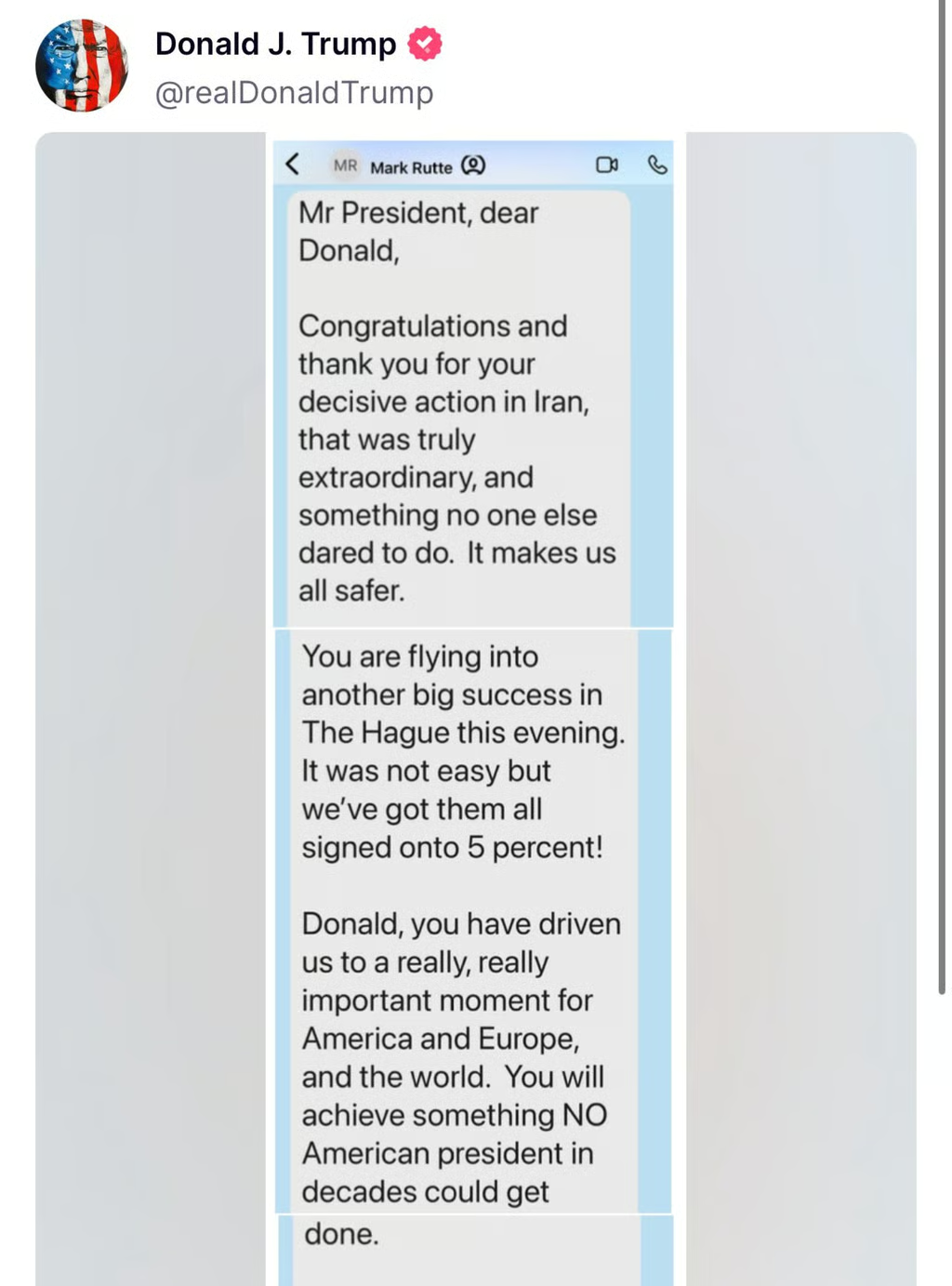
A private message between two of the most powerful men in the Western alliance system—turned into content.

Donald Trump, never one to let diplomacy get in the way of dominance, shared messages from NATO Secretary-General Mark Rutte praising his “decisive action” on Iran. There it was: flattery turned into ammunition. Trust weaponized. Screenshot diplomacy, playing out for a global audience like a reality show reveal.
The result wasn’t just spectacle. It was strategy. And it’s working.
A New Kind of Power Play
When Trump publishes a message like this, it’s not just about ego—it’s about creating a new operating system for global power.
He knows exactly what he’s doing. In one swipe, he:
- Silences dissent by publicly aligning NATO’s chief with his military aggression.
- Signals to European leaders: fall in line, or I’ll post the receipts.
- Reinforces the myth that real leadership looks like speed, violence, and unilateralism.
This isn’t a glitch in the system. It is the system now.
NATO as Stage, Not Strategy
The NATO alliance was built on collective security. Quiet deals. Trust forged in sealed rooms. But that infrastructure was always vulnerable to personality. What we’re witnessing is what happens when trust is replaced by Twitter threads, and cooperation is measured in emojis.
This isn’t diplomacy—it’s branding. Trump is branding NATO under his name, and Rutte, perhaps without realizing it, just gave him the tagline.
Europe, Cornered
What’s most revealing isn’t what Trump did—but how Europe responded.
Rutte confirmed the texts. He didn’t walk them back. And in doing so, he reinforced a dynamic where power is performative, loyalty is public, and criticism becomes treasonous.
Meanwhile, Trump floated demands that NATO members spend 5% of GDP on defense—an economic impossibility for most and a political non-starter for many. But the real goal isn’t implementation. It’s domination. The number doesn’t matter. The subjugation does.
The Invisible Winners
And behind this drama? The usual suspects.
Defense contractors. Oil interests. Opportunistic strongmen. Every flare-up justifies another budget increase, another arms shipment, another “emergency” suspension of oversight.
Follow the money, and you’ll find who truly benefits from turning private messages into public threats.
The Bigger Question
So what now?
Do alliances still mean anything when they can be upended by a screenshot?
Is NATO a security pact—or just another stage for the powerful to rehearse dominance?
Trump is betting that public performance will beat private principle. That loyalty is more about what you post than what you uphold. And unless someone challenges the terms of that bet, he might be right.
Elon Musk and the Quiet Reprogramming of American Democracy

The rise of a billionaire-powered political movement—and what it signals for the system itself.
This Is Not Just a Feud—It’s a Realignment
What looks like a petty social media fight between Elon Musk and Donald Trump is, in truth, the surface tension of a deeper political rupture.
On one side: Trump—the figurehead of traditional populism, reliant on rallies, legacy media, and the Republican base.
On the other: Musk—a tech mogul with no party allegiance, unmatched infrastructure control, and an active plan to reshape American political identity.
Their conflict isn’t about ego. It’s about who gets to define the future of power in America.
Musk’s “America Party” Is Not a Joke. It’s a Signal.
In early June, Musk floated the idea of creating a new centrist political party—possibly called the “America Party.” Over 5.6 million people responded to his X poll, and more than 80% voted “yes.” This wasn’t just noise. It was proof of a ready audience.
According to CBS, Reuters, and The New York Post, the idea is resonating for a reason: nearly 70% of Americans report feeling politically homeless. Musk is positioning himself not as a candidate, but as the architect of a new “solution.”
If this party materializes, it won’t function like a traditional third party. It will behave like a hybrid: part movement, part platform, part brand. And unlike past failed attempts at centrism, this one has what others lacked—money, reach, and a fully integrated media ecosystem.
Why Musk Doesn’t Need to Be Elected to Govern
Musk already owns the tools of modern influence:
- Discourse control: X is now the epicenter of political dialogue for the far-right, centrists, and dissidents alike.
- Data reach: Starlink satellites and Neuralink technology position him as a global communications provider.
- Physical infrastructure: Tesla, SpaceX, and the Boring Company give him physical access to transport, logistics, and orbital space.
- Narrative speed: With AI tools like Grok and a direct pipeline to millions, Musk can test, deploy, and amplify political messaging faster than any traditional media outlet.
He doesn’t need to win votes to shape the environment.
He shapes the terrain itself.
The System Isn’t Ready for This Kind of Player
Major outlets like Business Today and Politico have correctly pointed out that historically, third-party candidates have failed due to structural barriers: ballot access laws, first-past-the-post voting, and institutional inertia.
But Musk isn’t playing that game. He’s bypassing it:
- By activating millions directly through social platforms.
- By funding candidates who align with his values under existing party banners.
- By turning policy discourse into product testing.
He may never need to put his own name on a ballot to exert decisive influence. Instead, he could bankroll a fleet of candidates, rewrite public narratives, and shift the center of gravity in both parties.
The Republican Party Knows What’s Coming
The GOP is not blind to this.
According to Reuters, Republican lawmakers are increasingly worried about the Trump–Musk feud splitting the conservative vote ahead of 2026 and 2028. The fear isn’t just that Musk will “steal votes.” It’s that he will steal relevance.
As Trump’s brand weakens, donors and operatives are already seeking a new lodestar. Musk, with his appeal to tech-savvy youth, disillusioned centrists, and wealthy libertarians, offers an exit strategy. Quietly, a new coalition is forming.
What Happens Next?
If Musk follows through on the America Party—or simply throws full weight behind a curated set of candidates—we will see:
- Platform-driven politics: where citizen engagement, polling, and policy design happen in real time on X.
- AI-shaped governance: where campaign content is generated by models, not strategists.
- Billionaire-backed democracy: where the public gets to choose from options pre-filtered by elite interests.
This is not the end of democracy.
But it is the beginning of a privatized political era—where elections feel free, but the infrastructure of choice has already been built and bought

taking a break

The Sandbox of Power: When Billionaires Play, Democracies Pay
Two grown men. One with a golden tower. The other with a fleet of rockets.
This week, they weren’t building nations or guiding humanity to Mars.
They were fighting like exes on a group chat.
Trump vs. Musk.
The hot new couple on Love Island: Planet Earth.
Their relationship went off a cliff faster than a self-driving Tesla in beta mode.
Trump declared Elon “crazy.” Elon called Trump irrelevant.
The result? Stock markets shivered. Government contracts hung in limbo.
Space policy was rewritten in emojis and revenge.
This isn’t politics.
This is regression.
We are watching the world’s most powerful figures engage in ego-brawls with all the maturity of middle schoolers fighting over a cafeteria seat.
Only this time, the cafeteria is the Pentagon, and the spilled milk is $22 billion in federal contracts.
Where once diplomacy meant statesmanship, today it’s subtweets and humiliation games.
Public officials act like influencers. Tech tycoons cosplay as messiahs.
What used to happen behind closed doors now explodes in the algorithmic arena.
The entire world is collateral in their psychological theater.
Elon Musk hinted at pulling space launch support from NASA, while using x to tweet that Trump is on the Epstein files.Trump threatened to axe all his government funding.
This isn’t just drama. It’s national infrastructure being weaponized by emotion.
And this is not an isolated event.
We’ve seen it before:
Boris Johnson ridiculing Parliament with Churchill cosplay.
Berlusconi turning state television into a dating show.
Bolsonaro livestreaming conspiracy theories in a pandemic.
Now, Trump and Musk volleying tantrums while America’s space future dangles by a tweet.
The institutions are still standing—but the adults are no longer in the room.
And the cost?
Trust collapses.
Markets flinch.
Scientists and civil servants are forced to navigate policy through the fog of personality cults.
We have substituted governance with gossip.
Accountability with clapbacks.
Strategy with spectacle.
When leaders act like children, the people are forced to become parents—cleaning the mess, managing the fallout, and praying the power outage doesn’t hit during surgery or liftoff.
It’s not funny anymore. It’s fatal.
What does real leadership look like?
Not revenge. Not ridicule. Not theatrics.
It looks like restraint.
It looks like truth told without venom.
It looks like the discipline to hold power without letting it corrupt the soul.
Because in a world threatened by climate collapse, AI acceleration, and geopolitical volatility, we cannot afford to be governed by fragile egos in billion-dollar playpens.
We don’t need gods.
We don’t need kings.
We need adults.
And if they won’t rise, we must.