
Info

Archive for


It started with a text.
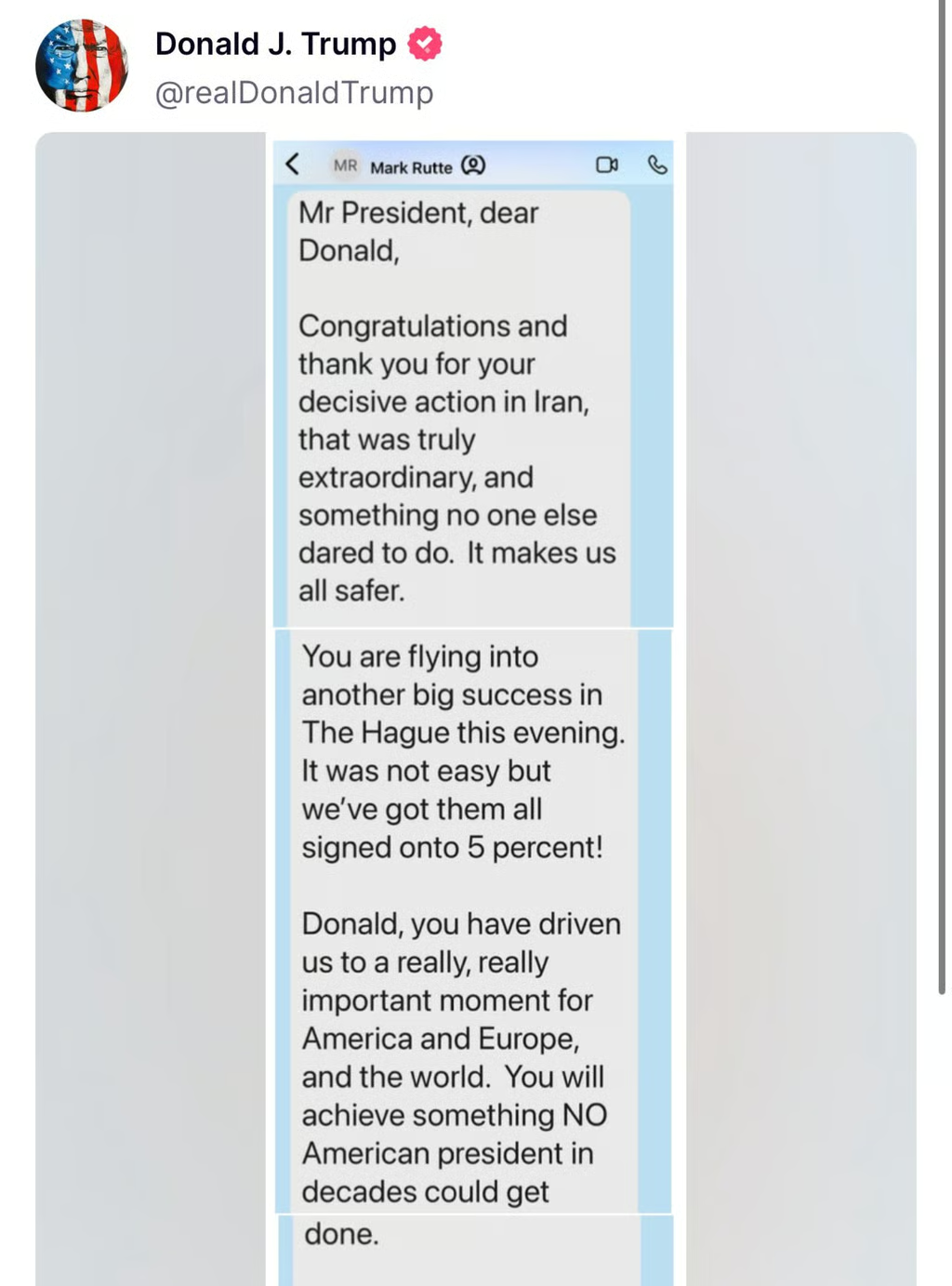

A private message between two of the most powerful men in the Western alliance system—turned into content.

Donald Trump, never one to let diplomacy get in the way of dominance, shared messages from NATO Secretary-General Mark Rutte praising his “decisive action” on Iran. There it was: flattery turned into ammunition. Trust weaponized. Screenshot diplomacy, playing out for a global audience like a reality show reveal.

The result wasn’t just spectacle. It was strategy. And it’s working.


A New Kind of Power Play

When Trump publishes a message like this, it’s not just about ego—it’s about creating a new operating system for global power.

He knows exactly what he’s doing. In one swipe, he:

  • Silences dissent by publicly aligning NATO’s chief with his military aggression.
  • Signals to European leaders: fall in line, or I’ll post the receipts.
  • Reinforces the myth that real leadership looks like speed, violence, and unilateralism.

This isn’t a glitch in the system. It is the system now.


NATO as Stage, Not Strategy

The NATO alliance was built on collective security. Quiet deals. Trust forged in sealed rooms. But that infrastructure was always vulnerable to personality. What we’re witnessing is what happens when trust is replaced by Twitter threads, and cooperation is measured in emojis.

This isn’t diplomacy—it’s branding. Trump is branding NATO under his name, and Rutte, perhaps without realizing it, just gave him the tagline.


Europe, Cornered

What’s most revealing isn’t what Trump did—but how Europe responded.

Rutte confirmed the texts. He didn’t walk them back. And in doing so, he reinforced a dynamic where power is performative, loyalty is public, and criticism becomes treasonous.

Meanwhile, Trump floated demands that NATO members spend 5% of GDP on defense—an economic impossibility for most and a political non-starter for many. But the real goal isn’t implementation. It’s domination. The number doesn’t matter. The subjugation does.


The Invisible Winners

And behind this drama? The usual suspects.
Defense contractors. Oil interests. Opportunistic strongmen. Every flare-up justifies another budget increase, another arms shipment, another “emergency” suspension of oversight.

Follow the money, and you’ll find who truly benefits from turning private messages into public threats.


The Bigger Question

So what now?

Do alliances still mean anything when they can be upended by a screenshot?
Is NATO a security pact—or just another stage for the powerful to rehearse dominance?

Trump is betting that public performance will beat private principle. That loyalty is more about what you post than what you uphold. And unless someone challenges the terms of that bet, he might be right.


In today’s Europe, the most powerful protest doesn’t always happen on the streets. It happens at the checkout counter.

A quiet revolution is unfolding in fast-moving consumer goods (FMCG). While most headlines focus on political elections or street demonstrations, the real shift is happening in everyday transactions. Consumers are no longer just buyers—they’re participants in a decentralized, daily form of activism.

YouGov’s latest European shopper research confirms it: price fairness, political sentiment, and brand origin are now driving purchase behavior across Europe in ways brands are failing to track, let alone respond to.


Consumer Trust Is Collapsing—and It’s Hitting the Shelf

According to YouGov’s Spring 2025 Behavior Change study, 70% of Europeans say they are worried about global political and economic instability. That’s not a mood—it’s a market signal.

Add to that YouGov’s EuroTrack data showing falling government approval ratings, and a clear picture emerges: as public trust in institutions erodes, people redirect their control to what they can influence—their purchases.

This isn’t abstract. It’s visible in cart data, loyalty drop-offs, and brand health declines.


Shopper Activism Is Not Loud. It’s Consistent.

The YouGov study maps out how activism plays out differently across Europe. Four shopper types are emerging:

  1. The Boycotter – Avoids products based on political origin (Nordics, Ukraine).
  2. The Buycotter – Intentionally supports national or local brands (Romania, Bulgaria).
  3. The Inflation Rebel – Reacts to price increases with long-term disloyalty (Serbia).
  4. The Emotional Shifter – Changes brand perception based on broader global sentiment (Denmark).

Each group expresses dissatisfaction differently, but they all operate with a shared logic: “My money has a message.”


Serbia: The Cost of Ignoring Frustration

In Serbia, a boycott sparked by perceived price-fixing led to a 35% drop in footfall at targeted retailers. Market share dropped from 46% to 35% in just one day, according to YouGov’s local panel.

While the initial impact was dramatic, follow-up efforts had less effect—likely because shoppers had limited alternatives. But this doesn’t mean the threat is gone. It shows that once the frustration is voiced, expectations shift. Retailers who respond late are already behind.


Denmark: Sentiment Over Supply

In Denmark, sentiment—not product quality—is driving brand value. With 92% holding an unfavorable view of Donald Trump and 36% likely to boycott based on country of origin, U.S. FMCG brands are seeing sharp consequences.

YouGov BrandIndex shows two major U.S. brands lost over 20% of their market value in Q1 2025, while a Danish competitor gained +330%, powered by a campaign that emphasized Danish roots and values.

Consumers didn’t just change products. They switched stories.


The Role of Localism and Identity

In Romania and Bulgaria, over two-thirds of consumers prefer local or national brands. Not because of political sentiment, but because they trust what they can trace.

In Germany and France, “locally produced” ranks above “national brand” in importance—highlighting a shift from emotional nationalism to practical proximity.

Retailers like Denmark’s Salling Group are adapting fast, using visual labeling systems (e.g., star-shaped icons) to help shoppers identify European-made products instantly.


Price Is No Longer Just Economics—It’s Ethics

The most underestimated insight from YouGov’s data is that price fairness is now a trigger for rebellion.

Consumers are not just looking for low prices. They are actively punishing brands they believe are manipulating pricing, inflating costs unjustifiably, or capitalizing on crisis.

This is the rise of the Inflation Rebel—a consumer who may not march or tweet, but who silently shifts loyalty, tells friends, and never comes back. They don’t write angry reviews. They just delete the brand from their wallet.


Strategic Implications for FMCG Brands

Most FMCG companies are still thinking in terms of cost and convenience. That’s no longer enough. In this climate, every product must pass four silent tests:

  1. Is this brand politically neutral—or politically problematic?
  2. Is this price fair—or opportunistic?
  3. Is this product local—or foreign in a tense climate?
  4. Is this brand acting transparently—or hiding behind marketing?

If your brand fails even one, you’re at risk.


What Comes Next

For brands:

  • US brands need immediate perception repair strategies—transparency, pricing clarity, and local partnerships can help.
  • European brands should double down on heritage, supply chain transparency, and shared values.
  • Retailers must make values visible—through signage, labeling, and curated shelves.

For strategists and marketers:
Stop treating price as a promotional lever. Start treating it as a trust signal. The emotional weight of pricing is heavier now than any time in the last decade.


Final Thought

This isn’t just a consumer trend. It’s a shift in economic behavior that blends politics, identity, and purchasing in ways that make brand strategy more complex—and more important—than ever.

The brands that win in this era will be the ones that read the room before they read the receipts.

Because in 2025, shoppers aren’t just buying products. They’re casting votes. And brands are on the ballot.

Inside the Digital Illusions of the Iran–Israel War

We’re not watching a war. We’re watching a screenplay produced by empires, edited by AI, and sold as reality.

In June 2025, a now-viral image of Tel Aviv being obliterated by a swarm of missiles flooded social media. It looked real—devastating, cinematic, urgent.

But it was fake.
According to BBC Verify journalist Shayan Sardarizadeh  , the image was AI-generated. And yet, it ricocheted across the internet, amassing millions of impressions before truth had a chance to catch up.
A second video claiming to show the aftermath of Iranian strikes on Israel was traced back to footage from entirely different conflicts. It was, quite literally, yesterday’s war dressed in today’s fear.

This is the battlefield now:
Not just land. Not just air.
But perception.


How the West Writes the Script

While both sides—Iran and Israel—have weaponized visuals and emotion, the West plays a more insidious role. Its manipulation wears a tie.

In The Guardian, Nesrine Malik writes that Western leaders offer calls for “diplomacy” without ever addressing the root causes. Israel’s strikes are framed as “deterrence.” Iran’s retaliation is “aggression.” Civilian suffering is background noise.

Even so-called restraint is scripted.
Reuters reported that Britain, France, and Germany urged Iran to return to negotiations—yet all three simultaneously approved arms shipments to Israel.
Their message is not peace.
It’s obedience dressed as diplomacy. Basically, they are hypocrites

Meanwhile, editorials like this one in Time express “grave alarm” at escalating tensions. But they stop short of condemning the architects of escalation. The West has a talent for watching wars it helped create—then gasping at the fire.


Not Just States—Extremists Are Watching Too

This conflict is not unfolding in a vacuum.
ISIS, through its al-Naba publication, is framing both Iran and Israel as enemies of true Islam—using the chaos to stoke hatred, attract followers, and promise vengeance.
They don’t need to fire a shot.
They just wait for our illusions to do the work.


Truth Isn’t the First Casualty—It’s the Target

So what happens when truth is no longer collateral damage, but the goal of destruction?

– A missile hits, and we ask not where, but which version.
– A death toll rises, and we wonder: is it verified? real? current?
– Leaders speak of peace while voting for war behind closed doors.

In this fog, apathy becomes defense. Confusion becomes allegiance.
And war becomes a franchise—a story you consume with your morning scroll.


How to Reclaim Your Mind

  • Verify before you amplify: Use tools like reverse image search, metadata extractors, and independent fact-checkers like AFP and BBC Verify. Search multiple sources.
  • Ask who benefits from the narrative you’re being sold.
  • Notice omissions: If Gaza disappears from the map while Tel Aviv gets front-page coverage, ask why.
  • Resist false binaries: You can oppose both regimes and still demand truth.

We live in mad mad world

You don’t have to pick a side.
You don’t have to parrot the scripts of Tehran or Tel Aviv.
But you do have to stay awake.

Because if they steal your attention…
They’ve already won.

Anna Haifisch via